
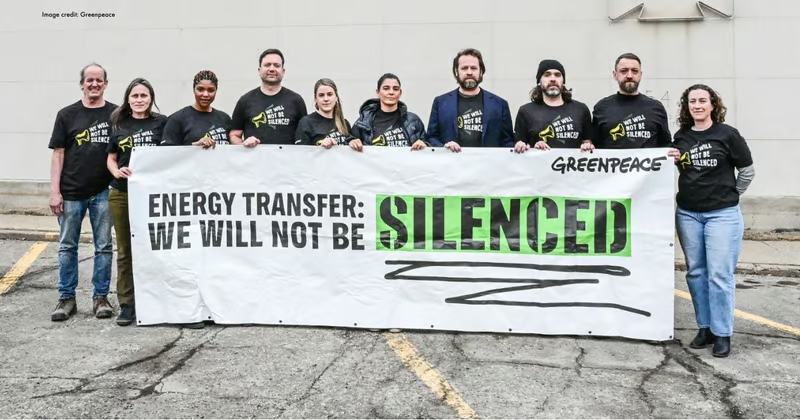
[31st of March, Loss and Damage Youth Coalition]
A jury has ruled against Greenpeace entities, holding them liable for over $660 million in a Strategic Lawsuit Against Public Participation (SLAPP) trial brought by Energy Transfer. This decision is a direct attack on climate activism and an alarming example of how powerful corporations weaponize the legal system to silence those fighting for environmental justice. SLAPP lawsuits are designed to intimidate and exhaust activists, organizations, and grassroots movements with costly legal battles. Instead of addressing the environmental and human rights concerns raised by climate defenders, corporations use these lawsuits as a tool to shut down dissent and deter future activism. This ruling does not just impact Greenpeace—it sets a dangerous precedent that threatens youth activists, Indigenous leaders, and frontline defenders worldwide. If legal intimidation becomes the norm, the fight against climate change and environmental destruction will face even greater obstacles.
Why Greenpeace's Campaign Against Energy Transfer's Dakota Access Pipeline Matters
The Dakota Access Pipeline (DAPL), operated by Energy Transfer, poses significant environmental and community risks, as evidenced by the company’s alarming track record of spills and regulatory violations. Between 2002 and 2017, Energy Transfer, Sunoco, and their subsidiaries reported 527 hazardous liquid pipeline incidents—equating to one spill every eleven days—releasing a total of 3.6 million gallons of hazardous liquids, including 2.8 million gallons of crude oil. These spills have contaminated water sources in at least 67 incidents, with 18 affecting groundwater, and have caused an estimated $115 million in property damage. Regulatory agencies have repeatedly flagged Energy Transfer for non-compliance, issuing over 100 notices of violation and at least six stop-work orders between 2017 and 2018 for environmental breaches during pipeline construction. Despite these dangers, DAPL and its southern component began operations in 2017 and have already reported seven spills, highlighting the stringent risks of the Dakota Access Pipeline. Greenpeace is campaigning against Energy Transfer’s Dakota Access Pipeline. As a result, the powerful corporation is weaponizing the legal system to silence & halt GreenPeace’s fight for environmental justice
Youth Respond With Strong Push Back To The Verdict: Quotes from Youth
We asked young leaders from the United States, Europe, and beyond to share their reactions to this verdict. Their responses highlight the urgency of defending the right to protest and ensuring that climate activists are protected, not prosecuted.
Alexandra Wenzel, United States – SLAPP suits are another tool used to silence dissent. Despite the backlash on human rights in the United States, we will continue to resist a chilling effect. We will continue to fight for a world and legal systems that protect the rights of all people, in particular the rights and sovereignty of Indigenous Peoples, rather than he interests of the ultra-rich and billion-dollar corporations. In the U.S., and around the world, we must continue standing together to reject the weaponization of the legal system by billion-dollar corporations to silence public participation. It is only by uniting together across our diverse movements that we can create a world where all people can live in dignity with justice for all.
Nils Michalke, Germany- Energy Transfer’s SLAPP lawsuit against Greenpeace exposes the fossil fuel lobby’s blatant abuse of the judicial system to silence dissent. But these tactics only amplify the people’s voices.
Johannes Temm, United States- This decision undermines the role of civil society in catalysing environmental justice. Corporate obstruction tactics are suppressing the very voices we need on loudspeakers. If we are to reclaim meaningful involvement in the climate transformations of our time, we must push not only BACK against this decision but also FORWARD, for the democratic model of governance and for new legal mechanisms based on active engagement and protections for activists. Policymakers must recognise that empowering and defending activists through inclusive, participatory processes is a prerequisite to achieving sustainable futures; not just ‘tolerating’ protest but actively integrating it with climate & environmental governance.
Mamadou Sylla, Senegal – Corporations will go to any far possible to just intimidate youth activists instead of addressing the environmental disaster. But, youth activists are resilient and no intimidation can back them down because when you are on the side of the truth, you are not afraid
This is more than just a lawsuit—it is an attempt to criminalize activism. But we will not back down. We call on global leaders, policymakers, and human rights organizations to stand against SLAPP lawsuits and defend climate defenders.
About Greenpeace
Greenpeace is an international organization dedicated to preserving endangered species of animals, preventing environmental abuses, and heightening environmental awareness through confrontations with polluting corporations and governmental authorities
About the Loss and Damage Youth Coalition
The Loss & Damage Youth Coalition (LDYC) is a global coalition of young activists, researchers, and working professionals from both the Global South and North advocating for increased public awareness and ambitious action on loss and damage (L&D) issues. To date, the LDYC has over 1300 members from 90+ countries working together to empower frontline communities and voices. We do advocacy, negotiation, research, grant-making, storytelling, and training. All these adding bits to ensure there are concrete actions to address loss and damage at local, national, and global levels.